
STORY
The decision rarely begins with the sofa itself. It begins with a room, with the way afternoon light settles across a timber floor, with the sense of stillness that a well-considered living space can hold. When the moment arrives to choose between a sectional sofa and a modular format, the real question is how you live and how your home might evolve around you.
Kett Furniture approaches that question as designers and makers. Every piece in Kett’s indoor sofa collections reflect Australian-made craftsmanship, with pieces made by hand by local artisans and manufacturers, guided by Design Director Justin Hutchinson’s commitment to furniture built to endure. This guide covers the core difference between the two formats, the honest pros and cons of each, how to plan configurations and room fit, and why material quality defines the outcome.
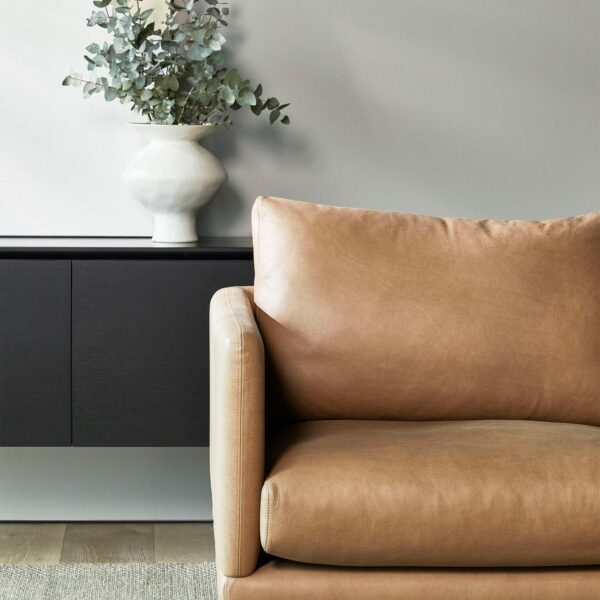
Erskine Sofa with generous cushions and a solid oak base
The two terms appear interchangeably in furniture retail, but they describe genuinely different things. A sectional sofa is made from fixed pieces that join together to form one continuous shape; once assembled, the configuration is essentially set. A modular sofa is built from independent units that can be rearranged, added to, or repositioned in a different home or room.
In practice, the distinction matters most when your circumstances change. A fixed configuration suits a settled household. An adaptable one suits a household that expects to move or evolve.
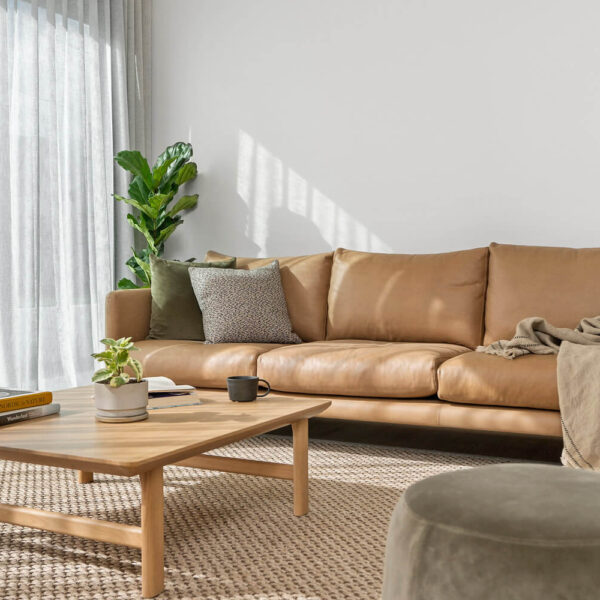
A sectional sofa works best when your room is settled and the layout is unlikely to change. The fixed format creates a clean, unbroken silhouette, and an L-shaped sofa in a generous living room reads as a single resolved piece rather than a collection of units. A corner sofa takes this further, anchoring the room with a confident, sculptural presence.
If you prioritise visual formality and a seamless cushion line, a sectional sofa rewards that preference well.
A modular sofa rewards households that expect change. You can configure it as a corner sofa today, add a chaise extension next year, and rearrange entirely when you move to a different space. For apartment dwellers, renters, or anyone whose household is still growing, this adaptability has genuine practical value.
For open-plan living areas, where the sofa defines a zone rather than occupying a defined room, the modular format also offers more compositional flexibility.
Neither format is universally superior. The right choice depends on your room, your habits, and how you weigh permanence against flexibility.
A sectional sofa delivers a composed aesthetic outcome that can be harder to achieve with independent modules. The joins are internal to the structure, the cushion geometry holds consistently across the piece, and the overall silhouette reads as considered and resolved. In a larger room where a sofa must anchor a space, the sectional sofa typically achieves this with greater authority.
The trade-off is adaptability. A sectional sofa is harder to relocate to a differently shaped room and cannot be reconfigured if your floor plan changes.
A modular format is practical over the long term. It moves house more easily, adapts to rooms of different dimensions, and allows individual units to be replaced or supplemented over time. For growing households or those who relocate regularly, this flexibility is a meaningful advantage.
The key quality consideration with modular pieces is the joinery at connection points. Well-engineered joins hold firmly over years of daily use. At the level of a handcrafted, made-to-order piece, this is rarely a concern, because the frame receives the same care as every other element.
Whether you are drawn to a sectional sofa or a modular arrangement, the shape of the piece should respond to the shape of the room. Planning this before ordering is the most important practical step you can take.
The L-shaped sofa and corner sofa are the most popular configurations in Australian homes. They suit rooms with one longer wall, open-plan living areas where the sofa divides a zone without enclosing it, and spaces where a bay or corner window creates a natural focal point. An L-shaped sectional sofa works especially well where the room has clear geometry and a settled function.
As a practical guide, allow at least 900mm to 1000mm of clearance in front of the sofa for comfortable movement. Check doorway and hallway access before ordering, particularly for sectional pieces that may not disassemble for delivery. The Avoca collection, for instance, is available in L-shape and chaise configurations suited to a wide range of room types.
A U-shaped sofa configuration suits larger rooms and households that seat many people regularly. It creates an enclosed, generous conversation area and is the most comfortable format for extended, relaxed use. A chaise extension offers a middle path: deep lounging depth on one side without the full visual weight of a U-shaped sofa configuration.
For families with children, or for a dedicated media room, these configurations provide the most comfortable and inclusive seating.
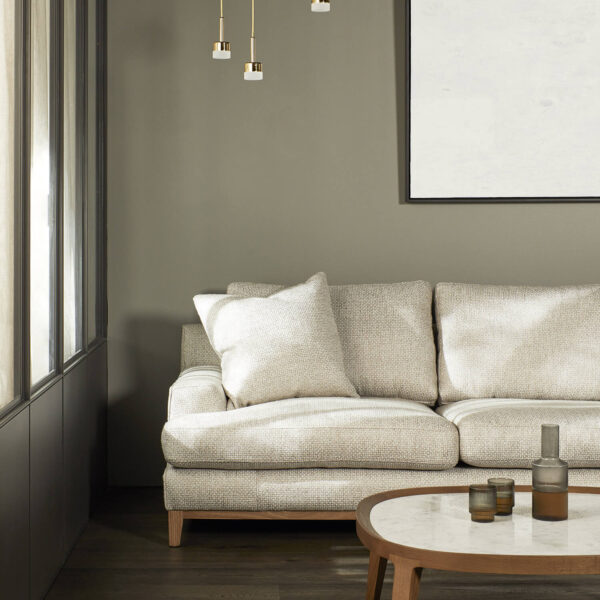

Belle Sofa in Fabric or Leather Upholstery & American Oak Legs
The sectional versus modular distinction matters far less than what lies inside the piece. A well-built sofa in either format will outlast a poorly constructed one by decades. At Kett Furniture, both formats begin with the same commitment to frame quality and material integrity that defines an Australian-designed sofa built to endure.
Kett offers performance weaves, fine leathers, and Australian wool boucle across its collections. Wool boucle is textural and warm, well suited to cooler climates and interiors with natural materials as a design theme. Performance weaves handle higher-frequency use and are forgiving to maintain. Fine leather develops a refined patina over time and remains one of the most considered choices for a long-term investment.
Seat cushion construction is equally important. A combination of high-density foam and feather-wrapped inserts provides firm support and generous softness, and holds its character over years of use.
The frame is the part of the sofa most buyers never see and the part that most determines how long a piece lasts. Pieces like the Otway collection and Erskin sofa reflect Kett’s focus on made-to-order upholstery, solid oak detailing and considered comfort, with construction details varying by collection.
The difference between a sectional sofa and a modular arrangement becomes clear only when you experience both in person. Photographs convey proportion and material, but not the specific quality of a seat depth, a cushion density, or the warmth of a fabric under your hand.
Kett Furniture is available exclusively through Cosh Living showrooms in Sydney, Melbourne, Brisbane, and Perth. Each showroom carries a curated selection of Australian-designed collections, and the team can guide you through configuration options, fabric selections, and the made-to-order process from first visit through to delivery.
Visit Cosh Living showrooms to find your nearest location and arrange a time to sit, consider, and choose with confidence.
Avoca Sofa in Fabric or Leather Upholstery & American Oak Legs
A sectional sofa is assembled from fixed pieces that form one continuous shape and cannot be reconfigured once assembled. A modular sofa is made from independent units that can be rearranged, added to, or repositioned when your space changes.
Not inherently. Durability depends almost entirely on frame construction, joinery quality, and fabric specification, not on the sectional versus modular distinction. A handcrafted, made-to-order piece in either format will outlast a mass-produced alternative.
A modular format typically adapts more easily to compact or irregularly shaped spaces, because individual units can be removed or rearranged. A smaller L-shaped sofa or corner sofa in a fixed format can also work well when the dimensions are carefully considered.
Yes, additional modules may be possible for some collections, so it is best to check current options and fabric availability with the Cosh Living showroom team.
Learn more
1 / 337 Bay Road
Cheltenham VIC 3192
03 9532 0464
melbourne@coshliving.com
Level 6, 600 Church Street
Richmond VIC 3121
03 9281 1999
melbourne@coshliving.com
Level 1, Suite 14-15
69 O’Riordan Street,
Alexandria NSW 2015
02 9317 3011
sydney@coshliving.com
130 Arthur Street
Fortitude Valley QLD 4006
07 3666 0377
brisbane@coshliving.com
21 King Edward Road
Osborne Park WA 6017
08 9415 2522
perth@coshliving.com