
STORY
Along the Victorian coastline, where weathered timber and salt air have shaped a design language for generations, the case for a wooden bed frame that endures has always been about more than appearance. It is about material honesty, patient construction and a belief that furniture should be made to outlast trends.
Kett carries that philosophy into its timber designs, combining considered material selection with craftsmanship suited to each piece.
This article looks at what actually makes a bed frame last decades rather than years, from the wood itself through to the joinery and design choices behind it. For anyone comparing wooden bed frames in Australia, understanding these fundamentals helps you choose one built for the long term.
The Erskine bed’s soft curves are perfect as a freestanding bed or set against a wall or Frame Bedroom system.
Not all timber performs the same way under nightly use. The species, density and how the wood is dried and finished all influence how well a bed frame holds its shape, resists wear and ages gracefully over years of use.
Solid wood bed frames are prized precisely because timber is a natural material with inherent strength, and that strength varies significantly between species. Understanding these differences is the first step to recognising genuine quality. Explore our range of wooden bed frame options to see how material quality shapes durability.
Hardwoods such as oak and ash are denser and more resistant to denting, warping and structural fatigue than softwoods like pine. This density is what allows a wooden bed frame to carry weight night after night without the joints loosening prematurely.
A well-made hardwood frame can provide a long working life when the design, joinery and care are suited to everyday use. Look for clear product specifications and maintenance guidance rather than relying on a fixed lifespan. Hardwood bed frame construction is, in effect, an investment in decades rather than a handful of seasons.
Beyond the timber species itself, the way a frame is built tells you a great deal about how long it will last. Look for genuine joinery methods such as mortise and tenon or dowelled joints, rather than screws and brackets alone holding panels together.
Slat spacing and support rail design also matter more than most buyers realise. Properly spaced slats distribute weight evenly and reduce strain on the frame, while a well-engineered support rail prevents the sagging that plagues cheaper wood bed frame construction over time.
This is where hardwood bed frame construction shows its advantage most clearly, in the small structural choices that prevent long-term failure.
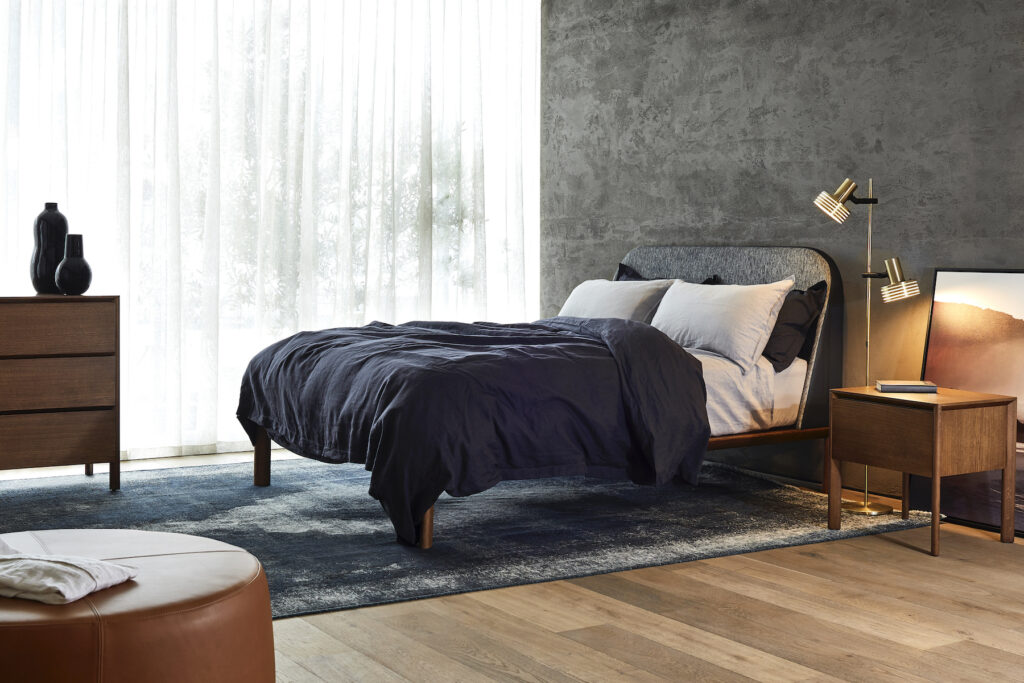
Kett Furniture’s approach to a wooden bed frame begins long before assembly, in the selection of timber and the planning of every joint. This is where the difference between mass production and handcrafted timber bed frames becomes clear.
Rather than relying on machine-only assembly, Kett’s construction is carefully considered through handmade techniques, allowing craftspeople to adjust for the natural variation in each piece of timber. That attention produces frames designed to last, to be cherished and passed down through generations.
Hand-cut and hand-fitted joints distribute stress differently to metal fasteners, which can work loose, rust or split surrounding timber over time. A well-executed hand joint, by contrast, often tightens gradually as timber settles, rather than loosening.
This is a defining reason why handcrafted timber bed frames retain their structural integrity for so much longer than frames assembled purely by machine with mechanical connectors as the primary structural element.
Every stage of fine bed frame woodworking, from selecting straight-grained timber to cutting tolerances measured in millimetres, shapes how the finished frame will perform. Small errors compound over years of use, while precision at the outset prevents them entirely.
This is the essence of genuine bed frame woodworking craftsmanship: not simply working with wood, but working with the exacting care that allows a piece to remain sound decades after it leaves the workshop.
Longevity is not only about how a bed frame is built, but also about what happens after years of daily use. Solid timber has a distinct advantage here that engineered alternatives simply cannot match.
When a bed frame is built from sustainable wood, it gains true durability through the ability to be restored and maintained. Discover our approach to solid timber construction that ensures lasting durability.
Because the material is solid rather than veneered or laminated, a genuine wood bed frame can be sanded back, re-oiled or re-tightened at the joints as needed, extending its useful life indefinitely rather than ending it at the first sign of wear.
Engineered board or veneered frames generally cannot be sanded or refinished without exposing the substrate beneath, which means minor damage often means replacement. Solid wood bed frames, by comparison, can be restored to near-original condition many times over.
This repairability is central to the idea of an heirloom timber bed frame, a piece intended to be maintained and handed down rather than discarded when it shows its age.
Thoughtful design accounts for how timber naturally moves with humidity and temperature. Allowing for grain direction and seasonal expansion in the construction phase means a bed frame settles into its shape rather than cracking under stress.
Choosing sustainable wood for a bed frame and designing around its natural properties ensures it improves with age.
These are the quiet design decisions that separate Australian-designed bed frames built for permanence from those built simply to look good on delivery day. This thinking is applied to every piece, treating longevity as a design requirement rather than an afterthought.
A wooden bed frame built on genuine hardwood, considered joinery and design that accounts for how timber ages is a piece meant to be lived with for generations, not replaced every few years. This is the philosophy behind every Kett Furniture design, where handmade techniques and Australian-designed detail come together in service of enduring quality.
These Australian-designed bed frames are the product of that same philosophy applied consistently, piece after piece, rather than reserved for a single showpiece collection. Each one reflects a belief that a bed frame should be chosen once and lived with for decades.
If you would like to see this craftsmanship firsthand, visit a Cosh Living showroom and explore how a genuinely well-made bed frame feels in person.
Alternatively, browse our curated collections online to discover the full range. Kett Furniture is available exclusively through Cosh Living, and every showroom visit is a chance to see this level of construction up close before you decide.
Choosing a bed frame raises practical questions about material, construction and care. Anyone weighing up a wooden bed frame Australia-wide tends to ask a similar set of questions, addressed below.
Dense hardwoods such as oak and ash consistently outperform softwoods for long-term durability. Their natural strength resists the daily stress of nightly use far better than lighter timber species.
Genuine joinery, such as mortise and tenon or dowelled connections, distributes weight and stress more evenly than screws or brackets alone. This is a major reason handcrafted timber bed frames tend to outlast mass-produced equivalents.
Yes. Because the timber is solid throughout, most timber bed frames can be sanded, re-oiled or have joints re-tightened, restoring the piece rather than requiring replacement.
Keep the frame away from direct heat and excess moisture, dust it regularly and periodically check joints for tightness. Occasional re-oiling or polishing, depending on the finish, helps preserve both appearance and structural integrity.
Learn more
1 / 337 Bay Road
Cheltenham VIC 3192
03 9532 0464
melbourne@coshliving.com
Level 6, 600 Church Street
Richmond VIC 3121
03 9281 1999
melbourne@coshliving.com
Level 1, Suite 14-15
69 O’Riordan Street,
Alexandria NSW 2015
02 9317 3011
sydney@coshliving.com
130 Arthur Street
Fortitude Valley QLD 4006
07 3666 0377
brisbane@coshliving.com
21 King Edward Road
Osborne Park WA 6017
08 9415 2522
perth@coshliving.com